OneCasino account verification in Ireland
 Available in US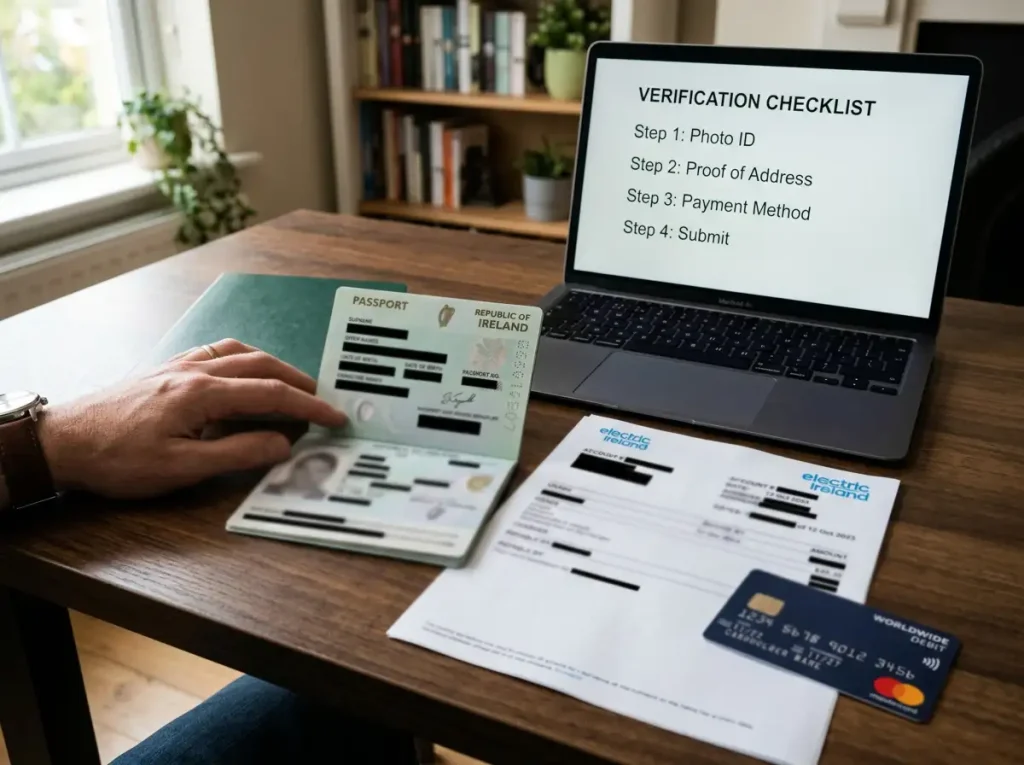
OneCasino uses age, identity and payment checks as part of account operation. Its terms allow requests for an ID card or passport, proof of address and payment verification, with additional source-of-funds or source-of-wealth documents where relevant. Extra checks can also arise around withdrawals and when deposits exceed €2,000.
The practical point is that account verification is not limited to a single registration screen. It can continue across payment and withdrawal activity as the operator checks that the account holder, payment method and origin of funds are consistent. OneCasino also provides session, wagering, loss and deposit limits, timeouts, self-exclusion, reality checks and account-closure controls, so verification and safer-gambling settings sit in the same account environment but serve different purposes.
Table of Contents
- Source-of-funds checks can appear before money leaves the account
- Limits and self-exclusion provide several layers of account control
- Payment instruments should belong to the account holder
- Verification starts with identity and can expand with account activity
- Questions about OneCasino account checks
- A consistent identity-payment trail makes account rules easier to navigate
- OneCasino payment methods in Ireland
Source-of-funds checks can appear before money leaves the account
OneCasino’s terms allow the operator to ask for source-of-funds or source-of-wealth material. These checks are financial-verification steps intended to establish where money used on the account comes from and whether the activity is consistent with the account holder. They are distinct from a basic identity check, which answers who controls the account rather than how funds were obtained.
The terms also allow additional checks around withdrawals. That means a cashout can be reviewed for identity, payment-method ownership and source of funds before it is processed. The withdrawal guide separates that review stage from later bank, card or wallet settlement, because document checks can delay approval before the payment rail receives the transaction.
Deposits above €2,000 are another trigger mentioned in the account terms. Crossing that amount does not by itself say what exact document will be requested, but it places the activity within a level where OneCasino can perform extra verification. Depending on the situation, material can include proof that links the player to the funds or explains their origin.
| Account stage | Checks that can arise | What the check addresses |
|---|---|---|
| Registration/account use | Age and identity verification; ID/passport; proof of address | Who controls the account and whether the personal details match. |
| Deposits above €2,000 | Additional identity and financial checks | Consistency of account activity and origin of funds. |
| Payment-method review | Payment instrument ownership | Whether the card, bank account or wallet belongs to the account holder. |
| Withdrawal | Identity, payment and source-of-funds material | Whether the withdrawal can be processed after account review. |
Because these are case-dependent checks, the useful preparation is consistency rather than trying to predict a fixed document list. The name and personal details on the account should match the payment method, and submitted documents should be current and readable. If a source-of-funds request is made, the relevant evidence needs to connect the player to the money used on the account rather than simply repeating identity information.
- Identity documents can include an ID card or passport.
- Proof of address may be requested alongside identity evidence.
- Payment methods can be checked against the account holder’s name.
- Source-of-funds or source-of-wealth material can be requested when the account activity requires a deeper financial check.
Limits and self-exclusion provide several layers of account control
OneCasino describes session, wagering, loss and deposit limits. These controls target different parts of play: a session limit restricts time or access across a session, a wagering limit controls the amount staked, a loss limit caps losses within the chosen framework, and a deposit limit restricts how much money can be added to the account.
Timeouts and self-exclusion are stronger interruption tools. A timeout creates a break from play, while self-exclusion is designed for a longer or more formal stop. Reality checks provide prompts during play, and account closure gives another route for ending access. These controls are more useful when set before a session becomes difficult to manage, because they convert a personal budget or time rule into an account-level restriction.
OneCasino’s terms also describe an important timing difference when limits change. Lowering a limit takes effect immediately. Increasing or revoking a limit has a seven-day cooling-off period. That asymmetry makes the safer direction fast and the less restrictive direction slower, reducing the chance that a limit is relaxed during a short-term decision.
- Choose a deposit or loss limit that reflects money available for gambling, not money needed for bills or savings.
- Use a session or wagering limit when time or repeated stakes are the main concern.
- Use a timeout when a temporary break is more appropriate than changing monetary limits.
- Use self-exclusion or account closure when a stronger stop is needed.
The account also connects automatically to Club One at registration, but loyalty status should not determine safer-gambling limits. Reward levels and account controls solve different problems: loyalty tracks programme progression, while limits and exclusions are there to contain gambling exposure.
For immediate support outside the account, the site-wide responsible-gambling information points to Extern Problem Gambling at problemgambling.ie and 089 241 5401, alongside the 24/7 national helpline on 1800 936 725. The legal gambling age is 18.
Payment instruments should belong to the account holder
OneCasino’s terms say payment instruments should belong to the person who owns the casino account. That links verification directly to deposits and withdrawals: the operator can compare the account name with the card, bank account or wallet used to move money. The rule is intended to reduce uncertainty about who funded the balance and where a withdrawal should be returned.
Third-party deposits can create a serious account problem. The terms allow a withdrawal to be refused or the account to be blocked when a payment instrument belongs to someone else, subject to the operator’s verification decisions. A family member’s card or another person’s wallet should therefore not be treated as an interchangeable funding route simply because the payment itself can technically be completed.
The same ownership logic works with the normal return-routing rule described in the payments guide: withdrawals are returned through the deposit method whenever possible, and the account-holder name is expected to match. Using one consistent payment route makes the transaction history easier to reconcile during verification.
| Payment situation | Account implication |
|---|---|
| Card/bank/wallet in the player’s own name | Consistent with the ownership rule and easier to match during review. |
| Third-party payment instrument | Can lead to withdrawal refusal or account blocking under the terms, subject to verification. |
| Withdrawal via original method | Used whenever possible to keep funding and return routes aligned. |
| Name mismatch | Can trigger additional payment or identity checks before money is released. |
Payment ownership is therefore more than a cashier preference. It is part of the evidence chain that connects the person, account and transaction. If those elements line up from the start, later checks have a cleaner record to follow.
Verification starts with identity and can expand with account activity
The basic OneCasino verification framework covers age, identity and payment details. An ID card or passport can establish identity, and proof of address can establish where the account holder lives. Payment verification adds another layer by checking that the person controlling the casino account also controls the payment instrument.
From there, account activity can make the review deeper. A withdrawal may trigger further identity or payment checks, while source-of-funds or source-of-wealth material can be requested when the financial activity needs additional explanation. Deposits above €2,000 are specifically mentioned as a point where extra checks can occur.
A practical verification sequence looks like this:
- Personal details: enter the account-holder information accurately and keep it consistent with formal documents.
- Identity/address: provide an ID or passport and proof of address if requested.
- Payment ownership: use payment methods belonging to the same person and provide payment evidence when requested.
- Financial checks: respond to source-of-funds or source-of-wealth requests with material that explains the money used on the account.
- Withdrawal review: allow for additional checks before the cashout moves to the bank, card or wallet settlement stage.
The process is easier when documents answer the exact question being asked. Proof of identity does not automatically prove payment ownership, and a payment screenshot does not necessarily explain the origin of funds. Keeping those categories separate helps make each request clearer.
Account verification also protects the integrity of safer-gambling controls. Limits, timeouts and self-exclusion need to apply to the correct person and account. Accurate identity and payment information therefore supports both transaction review and the practical operation of account restrictions.
Verification can also be easier to manage when records are kept in a form that can be matched without ambiguity. A payment statement should identify the same account holder, an address document should align with the account details, and financial evidence should relate to the funds being reviewed. This does not remove the operator’s ability to ask follow-up questions, but it reduces avoidable mismatches between identity, payment and financial information.
Questions about OneCasino account checks
What documents can OneCasino ask for?
OneCasino’s terms allow age and identity checks using ID or passport and proof of address, plus payment verification. Source-of-funds or source-of-wealth documents can also be requested in relevant cases.
Can verification happen at withdrawal?
Yes. OneCasino’s terms allow additional identity, payment and source-of-funds checks before a withdrawal is processed.
What happens with deposits above €2,000?
OneCasino’s terms say additional checks can occur for deposits above €2,000, including requests connected with identity and the origin of funds.
What safer-gambling controls are available?
OneCasino describes session, wagering, loss and deposit limits, timeouts, self-exclusion, reality checks and account-closure controls. Lowering a limit is immediate; increasing or revoking one has a seven-day cooling-off period.
A consistent identity-payment trail makes account rules easier to navigate
OneCasino’s account framework links identity, payment ownership and financial checks across the life of an account. Basic verification can use ID, passport and proof of address; activity can add payment or source-of-funds checks, including around withdrawals and deposits above €2,000. At the same time, session, wagering, loss and deposit limits, timeouts and self-exclusion give the player ways to restrict access or exposure. The most practical approach is to keep personal and payment details consistent, treat document requests as separate checks with separate purposes, and set gambling limits before they are needed under pressure.